Thursday, 19 March 2015

Opening Thriller Sequence Research - The Untouchables

The way the text is represented in this sequence is interesting as it engages the audience in a very simple way, by making the shadows of the title move therefore the audience is intrigue from the beginning of the sequence.


What's interesting in this title sequence is that there is no shots unfolding the storyline of this particular film, but instead what they do is that when they show the names of the actors is that they tell the audience who is who, for example Robert De Niro is Al Capone and this lets the audience understand what this film will be about as Al Capone is a very famous American gangster.


The font that they are using is very easy to read and also the contrast with the colour of the text and the background makes it, again, easier for the audience to read.

Considering the fact that this film was made in 1987, not many effects could of been used in order to present the title of this film but they zoom out the whole title sequence to show the title to the audience.


The reason why they decided to zoom out the whole title sequence is to show that something big is going to happen and what's big is The Untouchables and it gives this sense of suspense to audience which is what this targeted audience is looking for in a thriller. To reinforce the idea of the importance of this title is that when the title appears, there is a long pause for more text to appear so that the viewer's attention is on the title of the film, but then the text is placed underneath the title and in post-production they carry on this zooming out effect to show that something big is about to happen giving this nerve-racking feeling to the audience.


when the text disappears there's a sudden fade to black which gives the viewer a sense of wander where and where the story is going to start.
And then we have a straight cut to the first shot of the whole film which is very confusing for the audience as most thrillers would start with a chase scene for example but there it is just some man getting a shave.


The soundtrack during this title sequence is very stressful which again with the title adds to this nerve-racking feeling and it makes this title sequence effective as it makes the audience believe that something big is about to happen.
But when it cuts to the first shot, it kills the climax that was built when the text was showing as it makes the audience believe that the opening scene would be full of action and therefore it makes the audience interested in watching the rest of the movie as this film seems to be full of surprises.

Opening Thriller Sequence Research - Old Boy

With Old Boy's title sequence we see a strong theme of time going past. Through out the whole sequence we have this theme of time passing in a way representing all the years that the main character had spent imprisoned.


The Title sequences has a thin line text and from the animation of the text being removed for left to right, to then change from numbers to letters, we get the scene of a train station board or a alarm clock style of changing times. Through the sequence the text is changing colour from blue, purple, orange but mainly sticking with white, red and pale white. With the red this could be representing of the danger to come.
 

The sequence then goes into this disported views of a clock with shots dissolving into on another and a blurred effect sounding the clock. As well at that the hands on the clock are not moving but there is a digital stick that rotates like one of the handles but it has not just hours and minutes but also hours this can represent how long the character has been imprisoned and a furrowing.


We then go into the final sequence where we are presented with the title of the movie. We zoom out form a clock to see the a letter of the title and the for the title to expand from this single letter quite faded and to sort of role into place some even carrying of the screen. Then we still stick with this clock them where the end of both words, "D" and "Y", keep on rotating like clock handles, keeping this theme of passing time being a whole main point within the movie.


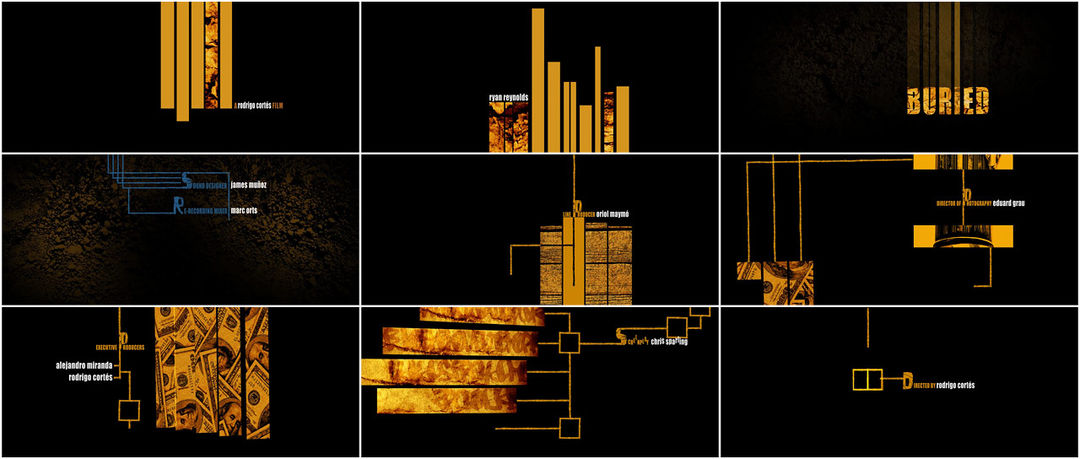
Opening Thriller Sequence Research - Buried


When original watching this title sequence the first thought to the audience will be that the text is rising but this is not the true effect of the writing use. While the text may scheme to be rising from the bottom and then being pulled away at the top, in fact the audience is sinking.
Buried
 
As stated before in the beginning of the sequence we don't really see this form of us, the audience, sinking, as the letter fade in from the bottom and at the top each float up. Even when graphical lines some with images of dirt in we still don't see this image of us falling.


This is until we see the title. When the title appears this is when we notice that we are skinning because of the dirt in the background gives a more stable view and we know that the ground can not float up and from the dark atmosphere we can only tell that we are traveling down through the ground and being buried ourselves. 
 
The writing then changes from is gold colour, that represents the ground, to a blue colour. From this change and from the graphical lines now becoming smaller and overlapping we can tell that these represent water lines the go underground. In a way the title opening is an establishing shot of just how far in the ground the character is located. We then go back to this gold colour writing but this time get image off bullets and money, this gold colour that we first represented with the ground is not representing danger and greed. This creates foreboding into the movie as now we know that someone is under ground and that it could do about money and a dangerous deal.


Transition Experiment

For a section of our film we need to create the illusion of time passing. In order to do this, we felt a dissolve/fade transition would most suit and conform to generic conventions of thriller therefore clearly showing time passing and allowing the audience to understand whats going on.

In order to have transitions you must have handles at either end of the clip you want to add to transitions. This is usually at the start of you clip where you say "speed, rolling, action" and leave it running at the end slightly when before you say cut.

Then you can easily add by 


Here is us expirementing we a few of our clips to find the perfect transition. In this clip we use
- Dip to colour dissolve
- Cross dissolve 
- Dither dissolve
- Fade in fade out dissolve
- Ripple dissolve